Years On, Zelda: Tears of the Kingdom Player's No-Surface Run Reminds Us How Limitless Hyrule Can Be
When Nintendo unleashed The Legend of Zelda: Tears of the Kingdom in 2023, it handed players a sandbox of near-corrupting freedom. The skies above Hyrule, the depths below, and the familiar surface formed a tri-layered playground where the only real boundary was imagination itself. Yet even in this age of creativity, one feat stands as a monument to sheer audacity—a run completed by a player who never once set foot on the surface of Hyrule after the tutorial. Their accomplishment, first shared years ago, continues to circulate in community lore as a masterclass in exploiting every nook of the sky-bound architecture.
Reddit user Black_Hand_Gotthard began their journey with a seemingly minor idiosyncrasy: they located the Master Sword before ever claiming the paraglider. In any ordinary playthrough, the paraglider is the first tool Link receives after leaving the Great Sky Island, serving as the literal safety net that cushions every leap into the unknown. But this player treated the paraglider not as a necessity, but as a crutch. They hopscotched across the sky archipelago using Zonai Wings, floating platforms, and custom contraptions that looked like winged insects built from divine scraps. It was a process as delicate as a tightrope walker crossing a chasm with a borrowed ladder—every craft was a gamble, and every island a half-second reprieve from a fatal fall.
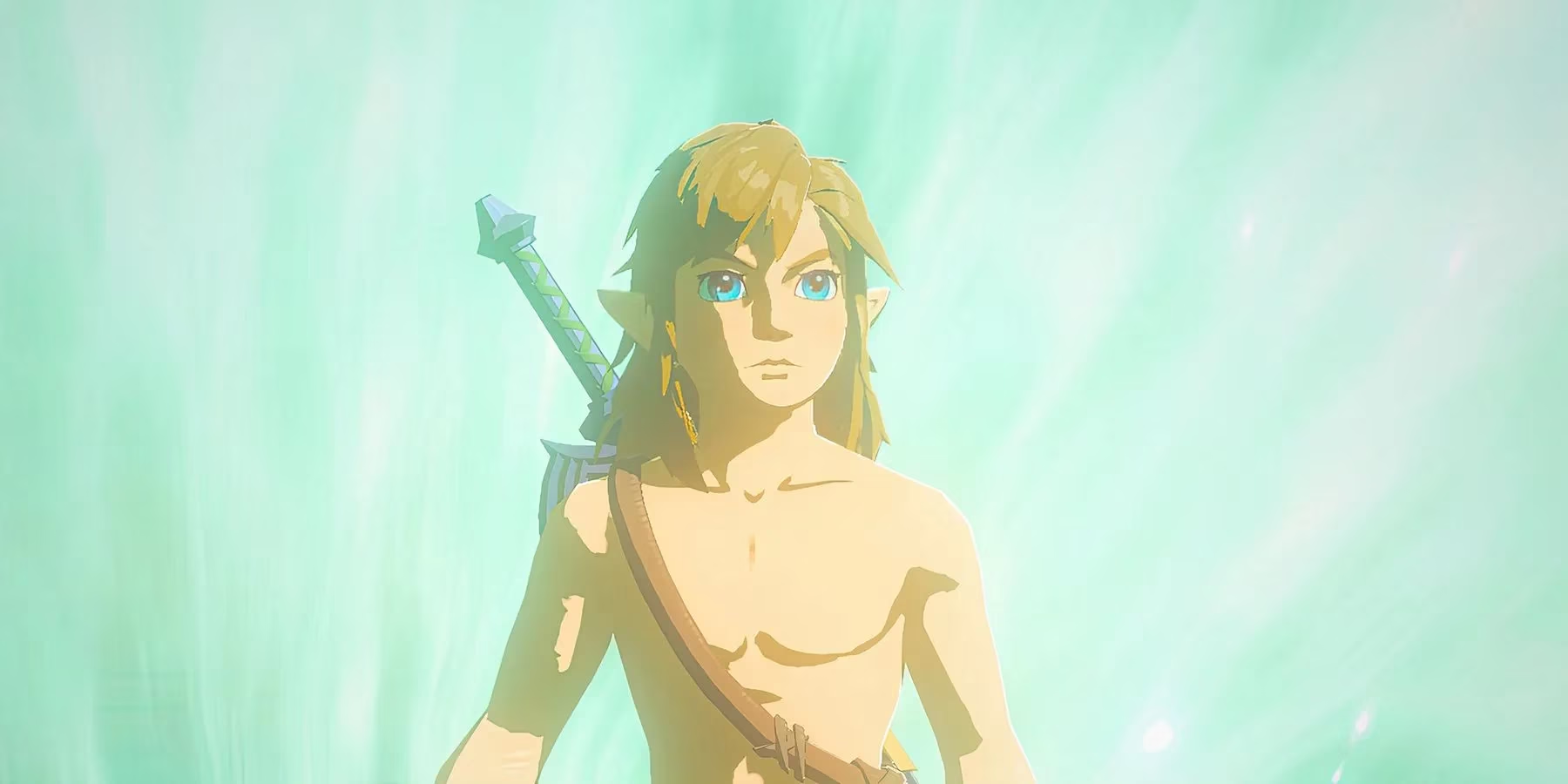
The real twist came when they decided to scale the challenge to an almost mythical level: finish the entire game, including the Demon King’s army and the final confrontation, without touching the surface of Hyrule even once. To contextualize, that means no accidental landings on a grassy plain while gliding too low, no emergency dives into a lake, and certainly no casual strolls through Lookout Landing. The sky became not just a prologue but the entire stage. For hearts and stamina upgrades, they wrung every last shrine from the Sky Islands—all 32 of them, which is barely enough for a full stamina wheel and a handful of extra hearts. This self-imposed scarcity turned each battle into a high-wire act where a single mistake could send Link plummeting through the clouds with no fabric wing to arrest the tumble.
If the paraglider is Hyrule’s heartbeat, fairies are its whispered secret. Black_Hand_Gotthard turned resurrection into a mechanic as routine as blocking. Because diving directly into the Hyrule Castle Chasm from a sky island would normally be a terminal dive, they stockpiled fairies—those laughing, tiny spirits that revive Link upon death. The strategy was a macabre ballet: embrace the impact, let the fairy undo the catastrophe, and scramble onto solid ground before the next misstep. It evoked images of a clockmaker resetting a delicate mechanism mid-fall, all cogs and springs snapping back into place just in time. This combination of fairy reliance and skybound navigation allowed the player to descend into the final boss gauntlet without ever registering a single footprint on Hyrule’s soil.
Their inventory, shared alongside the victory screenshot, was a manifesto of minimalist survival. No paraglider icon sat in the corner—its absence as conspicuous as a missing limb. The Master Sword, earned through the Light Dragon interception high above the cloud sea, was the primary weapon. A small constellation of cooked meals and enough Zonai charges supplied the energy for further contraptions. In a way, the entire run resembled a spacecraft mission on a shoestring budget: every course correction had to be plotted from floating barges, every oxygen tank (heart container) was scraped from shrines, and gravity was a cold companion that would never offer mercy.
What makes this achievement even more staggering is the quiet, poetic rebellion it represents. Nintendo’s designers planted curiosity on the surface with stable trotters, sprawling caves, and roads thick with NPC chatter. To ignore all of that is to reject the very invitation the game extends. It’s akin to building a cathedral on the head of a pin—the structure exists only because the builder refused to accept that the space was too small. Black_Hand_Gotthard’s run exposes the layered elegance of Tears of the Kingdom’s verticality: the sky is not an appetizer but a full course, provided one is stubborn enough to starve elsewhere.
In the years since its release, other players have pushed the paraglider-less envelope, defeating multiple temples without the winged cloth. Yet the no-surface run remains a golden marker, proof that even a game mapped to the millimeter can be turned into an alien planet. It asks a deeper question about how we define “intended” play. Did Nintendo ever predict someone would treat Hyrule’s surface like a poison ocean? Probably not. But they engineered systems elastic enough to accommodate a person who decides that falling is just another form of travel. As Tears of the Kingdom settles into its legacy on the Switch and beyond, stories like this remind us that the real master sword isn’t in the game—it’s in the hands of the community, forever swinging at the boundary between what is possible and what is forbidden.
Based on evaluations from ESRB, it’s easier to frame why Tears of the Kingdom’s self-imposed “no surface, no paraglider” run feels so extreme: the game’s systems openly support risky physics experiments, frequent combat, and high-stakes falls, so removing the intended safety net forces every sky-to-depth transition into a calculated gamble. That kind of challenge run spotlights how Nintendo’s open-ended toolset—Zonai devices, limited healing, and revive mechanics—can turn a standard action-adventure power curve into an improvised survival puzzle where one mistake means a long reset or a fairy-fueled recovery.