When Godzilla Emerges From Hyrule's Seas: Witnessing a Fan's Monstrous Creation in Tears of the Kingdom
As a lifelong gamer who has explored countless digital worlds, I can confidently say that few experiences come close to the unbridled inventiveness sparked by The Legend of Zelda: Tears of the Kingdom. Even now, in 2026, long after the credits first rolled for millions of players, the community continues to unearth mind-blowing feats of engineering and artistry from its sandbox. One creation, however, has lived rent-free in my mind since I first saw it back in 2023—a breathtakingly chaotic crossover that transplanted cinema’s most iconic kaiju directly into the peaceful shores of Lurelin Village.
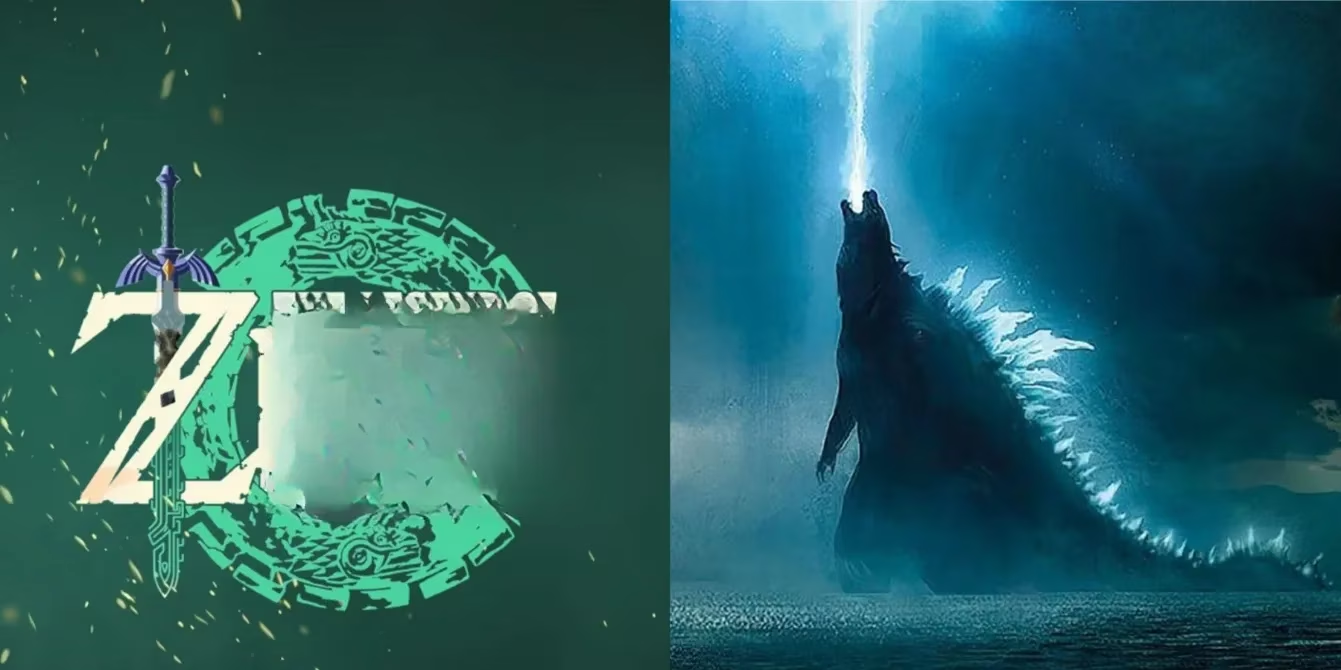
I still recall scrolling through my feed when a video from a Twitter user known as sumoguri2323 stopped me in my tracks. There, emerging from the Hyrulean sea with deliberate, thundering steps, was Godzilla. Not a mod, not a filter, but a fully functional, fire-breathing, tail-lashing behemoth assembled entirely from Zonai devices and common materials. The sheer ambition of the build hit me immediately. This was no static statue; it was a living, rampaging disaster movie realized inside a video game that already felt like a masterpiece of freedom.
The genius of Tears of the Kingdom lies in tools like Ultrahand and Fuse, which transform Hyrule into a vast playground where the only limits are your imagination. I’ve spent hundreds of hours experimenting with Zonai devices—those ancient, magical components that let you conjure everything from simple gliders to pulse-emitting death tanks. Players have built catapults that replicate Angry Birds, automated mining rigs, and even mechs that would make a Zonai engineer blush. But sumoguri2323’s Godzilla redefines what I consider possible within the game’s physics and logic.
The video itself is a miniature cinematic spectacle. The kaiju surfaces near the coastal settlement of Lurelin, a village already infamous among players for its destitute state when Link first arrives. With painstaking detail, the creator used flame-based emitters to simulate Godzilla’s atomic breath, sending waves of fire cascading into the wooden huts. Its massive tail, likely constructed from a chain of sleds, boards, and stabilizers, swung in wide, devastating arcs that sent the poor villagers—and the Zonai-built tanks they desperately deployed—flying. Those tanks, armed with stuttering laser beams, looked valiant but tragically mismatched, very much like the futile military responses in classic monster films. I found myself rooting for the beast as much as I pitied the digital defenders, a testament to how deeply immersive this fan-made clip became.
What truly elevates this piece is the presentation. sumoguri2323 layered in dramatic music and authentic sound effects, transforming a simple gameplay capture into a piece of cinema that earned nearly twenty thousand likes and waves of admiration. People called it fantastic, cinematic, and wholly on brand for a franchise as influential as Godzilla. I saw a parallel that others pointed out, too: the lizard-like mechanical silhouette also echoes the Green Ranger’s Dragonzord from Mighty Morphin Power Rangers, a nostalgia bomb that made me grin in recognition. This kind of multi-layered pop culture fusion is exactly why I adore the Zelda creative community.
Looking beyond the laughter, this Godzilla rampage symbolizes the everlasting heartbeat of a game that refuses to fade. Tears of the Kingdom never received a traditional New Game+, and yet its replayability is practically infinite because the gameplay loop is tied to imagination, not just progress. I’ve seen players treat Hyrule as a canvas for stop-motion recreations, flight simulators, and even rudimentary computers. The ripple effects have reached real-world academia, too. The University of Maryland introduced a mechanical engineering course inspired directly by the game’s building mechanics, a move that made headlines and confirmed what many of us already knew: this is more than a game—it’s a design philosophy.
My own journey with the title has evolved since 2023. I’ve moved past simply hunting Koroks and now spend evenings designing useless but wonderful contraptions that make me feel like a mix of Leonardo da Vinci and a gleeful child. The Godzilla video remains my go-to example when friends ask why I’m still tinkering in a three-year-old game. It reminds me that the world of Hyrule is not static; it’s a living library of every player’s craziest dreams. Whether it’s a legendary lizard stomping through a fishing hamlet or a fleet of Zonai bombers blotting out the sky, each creation adds a new tale to the land.
In 2026, the Tears of the Kingdom community may not dominate the news cycle, but it has matured into a tight-knit group of engineers, artists, and storytellers. Creations akin to sumoguri2323’s Godzilla still surface regularly, each one pushing the envelope a little further. I’m excited to fire up my Switch tonight, grab some stabilizers and flame emitters, and try my hand at an homage. Because if a kaiju can tear through the calm shores of Hyrule and be met with applause rather than frustration, then there is truly no limit to what we can build—and destroy—together.
Data referenced from CNET - Gaming helps frame why Tears of the Kingdom’s Zonai-device sandbox still feels fresh years later: it sits at the intersection of playful creativity and practical tech thinking, where physics systems, emergent problem-solving, and player-made “machines” can be discussed almost like consumer engineering. That lens makes feats like the Lurelin “Godzilla” build read less as a one-off meme and more as a natural outcome of a toolset designed to let players prototype, iterate, and stage cinematic experiments inside a living world.