The Puzzling Flat Rivers of Hyrule: A Quirk in Tears of the Kingdom's World Design
In the vast, immersive world of The Legend of Zelda: Tears of the Kingdom, players have encountered floating sky islands, formidable monsters, and countless hours of exploration and creative construction. Since its 2023 release, this sprawling open-world adventure has been celebrated for its beautiful and fantastical version of the real world. The landscape of Hyrule remains largely similar to its predecessor in Breath of the Wild, accounting for the passage of time and the kingdom's rebuilding efforts. However, amidst all the wonder and meticulous environmental design, a remarkably subtle and strange detail about this beloved world has recently come to light, one that most players, even after hundreds of hours of gameplay, have completely overlooked.
The Discovery: Rivers Without a Slope
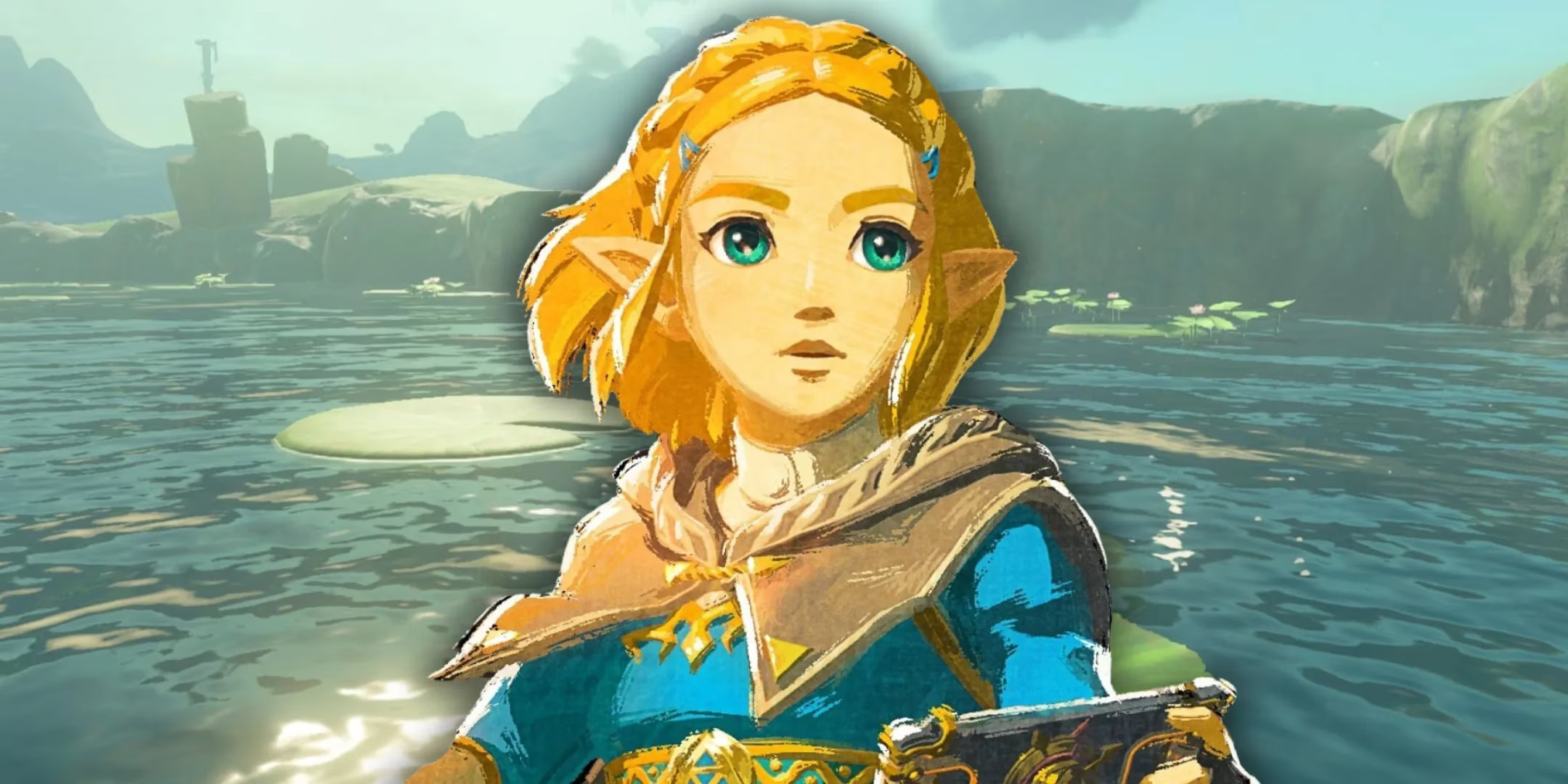
In 2026, a fascinating observation was popularized by the insightful YouTuber Any Austin, who dedicated a deep-dive video to analyzing the hydrography of Tears of the Kingdom. The revelation is both simple and bizarre: the rivers and streams in Hyrule are completely flat. They possess no gradual elevation changes whatsoever. Unless a player encounters a dramatic waterfall, the water bodies exist on a perfectly level plane, with no gentle slopes or dips to suggest a natural downhill flow from source to outlet. This discovery raises immediate questions about the world's internal logic, especially considering the game's otherwise rich and detailed geography. 🏞️
-
The Flat Grid: Rivers do not meander down hillsides. They sit on what appears to be a flat grid within the game's engine.
-
Disconnected System: Austin's analysis also pointed out that the river network doesn't seem to logically connect to a larger ocean or terminal body of water in a physically coherent way.
-
The Waterfall Exception: The only place where water visibly changes elevation is at predefined waterfall locales, creating a stark, binary contrast between "flat" and "vertical" flow.
It's a testament to the game's captivating magic that this geographical oddity went largely unnoticed by the community for so long. Players were too busy building elaborate vehicles with the Ultrahand ability, exploring ancient depths, and fighting Ganon's forces to scrutinize the exact topography of every waterway they sailed. 🤔
Why Would Developers Make This Choice?
While it may seem like an oversight, this design is almost certainly an intentional technical and gameplay decision by Nintendo's developers. The sailing and vehicle-building mechanics, central to Tears of the Kingdom's exploration, likely drove this choice.
| Potential Reason | Development & Gameplay Benefit |
|---|---|
| Simplified Physics | Managing water flow, current, and buoyancy on a slope adds immense complexity to the game's physics engine (Havok). |
| Streamlined Sailing | Building and piloting rafts, fan-boats, and other vessels is more predictable and user-friendly on flat water. No unwanted drifting or grounding on inclines. |
| Consistent Gameplay | It ensures a uniform experience. A player's crafted creation will behave the same way on any river, anywhere on the map. |
If rivers had realistic elevation changes, it could have led to frustrating gameplay moments where player-built vessels get stuck or behave erratically on invisible slopes. In prioritizing fun, fluid player movement and creative freedom, the developers opted for a simplified, magical reality where water defies conventional hydrology.
The Magic of a Fabricated World
Ultimately, this quirk serves as a charming reminder that Hyrule is a meticulously crafted video game world, not a terrestrial simulation. While it shares many familiar features with our reality, it operates on its own magical rules. 🧙♂️✨
-
Suspension of Disbelief: Players accept floating islands held aloft by ancient magic, so perfectly flat rivers are just another part of the fantasy.
-
Gameplay First: The design philosophy prioritizes engaging mechanics and exploration over rigid geographical realism.
-
A Unique Signature: This subtle oddity is now a fun piece of trivia that adds to the unique identity of this iteration of Hyrule.
Analyzing the map direction of rivers or the logic of watersheds is an entertaining thought exercise, but Tears of the Kingdom's primary goal is to deliver an unforgettable adventure. The flat rivers are a small, deliberate trade-off for a world that feels incredibly dynamic and interactive in countless other, more impactful ways. After all, if we applied strict scientific scrutiny, the very existence of the Sky Islands would present fundamental conundrums that defy explanation! The magic lies not in perfect realism, but in the sense of wonder and possibility the world inspires.
This delightful discovery enriches the conversation about game world design. It shows that even in a masterclass of environmental creation like Tears of the Kingdom, practical magic often wins over pure realism, and players are happier for it. The next time you sail down the Zora River or across Lake Hylia, you might smile, knowing you're gliding across a perfectly magical, perfectly flat plane of water, and that's exactly how the developers intended it. 🛶