The Legend of Zelda: Echoes of Wisdom - Carrying the Torch of Innovation Forward
For decades, The Legend of Zelda franchise built its legacy on familiar foundations: a heroic Link, a structured narrative, and a curated adventure through Hyrule. That tradition was spectacularly upended in 2017 and again in 2023 with Breath of the Wild and Tears of the Kingdom. These titles didn't just innovate; they redefined what a Zelda game could be, trading linearity for vast open worlds and predetermined tools for emergent, player-driven creativity. Now, in 2026, the franchise stands at another crossroads. Rather than retreating to the comfort of its past, The Legend of Zelda: Echoes of Wisdom boldly chooses to preserve and evolve the revolutionary legacy of its immediate predecessors, proving that the series' future lies in continued daring innovation.
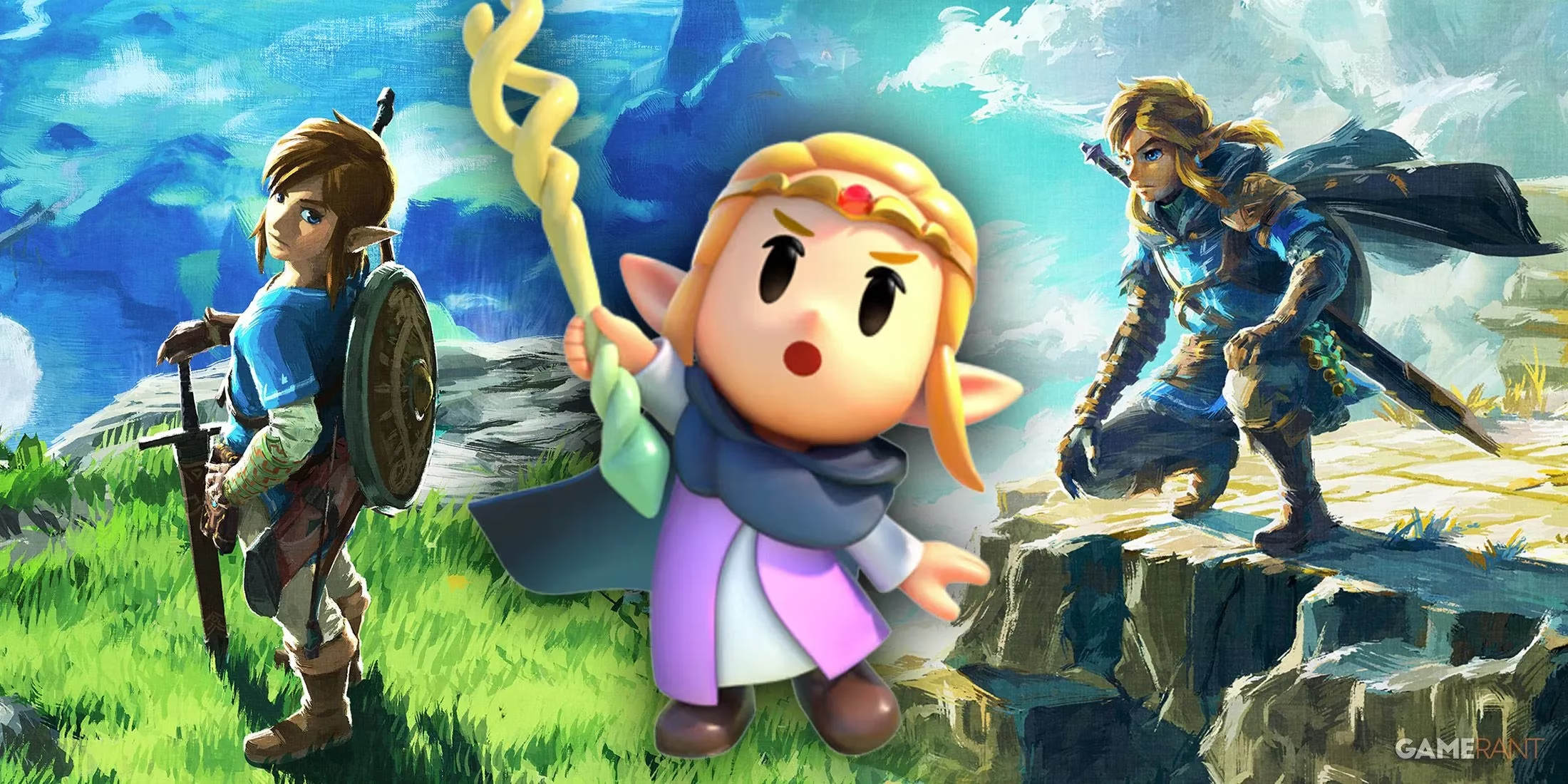
The shift from the classic Zelda formula to the philosophy of Breath of the Wild was monumental. It wasn't a simple update; it was a paradigm shift for the entire action-adventure genre. The series exchanged tightly designed dungeons for a sprawling, climb-anything open world that became the new industry benchmark. Link's iconic, unbreakable Master Sword was joined (and often replaced) by a fragile, scavenged arsenal, a system that prioritized survival and adaptability over permanent progression. Stamina meters and unforgiving enemies added layers of challenge that demanded new strategies. This was a risky, bold direction that paid off immensely, reshaping player expectations forever. To abandon this hard-won progress for nostalgia would be, as many fans and critics argue, a disservice to the franchise's evolution.
This is where Echoes of Wisdom makes its critical stance clear. It is not a retreat. While the game's world scale appears more intimate, reminiscent of the classic titles' more manageable realms, its core design philosophy is decidedly forward-looking. The most immediate and groundbreaking change is the protagonist. For the first time in the mainline series, players will not guide Link on his quest. Instead, the spotlight shines on Princess Zelda herself, wielding the mystical Tri Rod. This simple change reframes the entire narrative and gameplay perspective, offering a fresh lens through which to experience Hyrule.
The Tri Rod is far from a simple reskin of Link's sword. Early analysis suggests it functions as a spiritual successor to the Ultrahand ability from Tears of the Kingdom. Where Ultrahand allowed for boundless physics-based construction, the Tri Rod seems to grant Zelda a different kind of creative authority—perhaps manipulating echoes of objects, memories, or even time itself to solve puzzles and overcome obstacles. This indicates that Nintendo isn't discarding the "creative liberty" cornerstone of the new era; they are transforming it. The goal remains providing players with multiple solutions and routes, but the means to achieve that freedom are being reinvented, ensuring the experience feels novel and not derivative.
🔍 Key Innovations in Echoes of Wisdom vs. Traditional Zelda:
| Feature | Traditional Zelda (Pre-BotW) | Breath/Tears Era | Echoes of Wisdom (2026) |
|---|---|---|---|
| World Design | Linear, dungeon-focused | Massive, seamless open world | Focused, explorable hub-world |
| Progression | Item-gated (e.g., Hookshot) | Player-skill & resource-gated | Tool-based creative problem-solving |
| Core Mechanic | Sword & Shield combat | Physics & Chemistry systems | Tri Rod & "Echo" manipulation |
| Protagonist | Link | Link | Princess Zelda |
Nintendo's commitment to progress is refreshing. Breath of the Wild and Tears of the Kingdom were seismic events that permanently altered the franchise's DNA. Echoes of Wisdom acknowledges this new reality. It doesn't try to pretend the last decade of innovation didn't happen. Instead, it asks: "How can we build on this foundation in a new, exciting way?" By centering Zelda and her unique abilities, the game promises a distinct flavor of adventure while maintaining the series' renewed commitment to player agency and discovery.
The journey forward is not without its challenges. Some long-time fans yearn for the structured dungeons and predictable weapon durability of old. Yet, Echoes of Wisdom seems to be seeking a middle path—not a return to the past, but a synthesis. It offers the curated charm and narrative focus of classic Zelda through its protagonist and world design, while fully embracing the systemic, player-driven gameplay that defines the modern era. It's a testament to the developers' confidence that they can continue to innovate within the new framework they've built.
In the end, The Legend of Zelda: Echoes of Wisdom stands as a powerful statement. It confirms that the series' most successful revolutions are not one-off experiments but the foundation for its future. By carrying the torch of innovation lit by Breath of the Wild, the game ensures that The Legend of Zelda remains not just a beloved relic, but a living, evolving legend, always striving for higher heights.
According to coverage from Polygon, the most telling way to read The Legend of Zelda: Echoes of Wisdom is as a continuation of Nintendo’s modern design doctrine: empower players with flexible systems rather than funnel them through a single “correct” solution. That lens fits the blog’s argument that Zelda’s Tri Rod isn’t merely a new gimmick, but a deliberate evolution of the sandbox thinking popularized in Breath of the Wild and Tears of the Kingdom, preserving player agency even within a more focused, classic-feeling scope.