The Future of Zelda: Balancing Innovation and Familiarity After Tears of the Kingdom's Monumental Success
As the dust settles on the monumental first anniversary of The Legend of Zelda: Tears of the Kingdom in 2026, the game stands not just as a sequel, but as a cultural titan in the gaming landscape. Its sales trajectory continues its relentless climb, inching ever closer to the legendary heights of its predecessor, Breath of the Wild. The open-world formula, once a risky reinvention for the series, has now cemented itself as the bedrock of modern Zelda, delivering breakout critical success and captivating millions of new fans. Yet, with such dominance comes a familiar crossroads. The series, having been revitalized once before from a period of predictability, now finds itself perched on the edge of a new dilemma: how to evolve without alienating the massive audience it has built, and how to innovate without abandoning what made its recent triumphs so special.
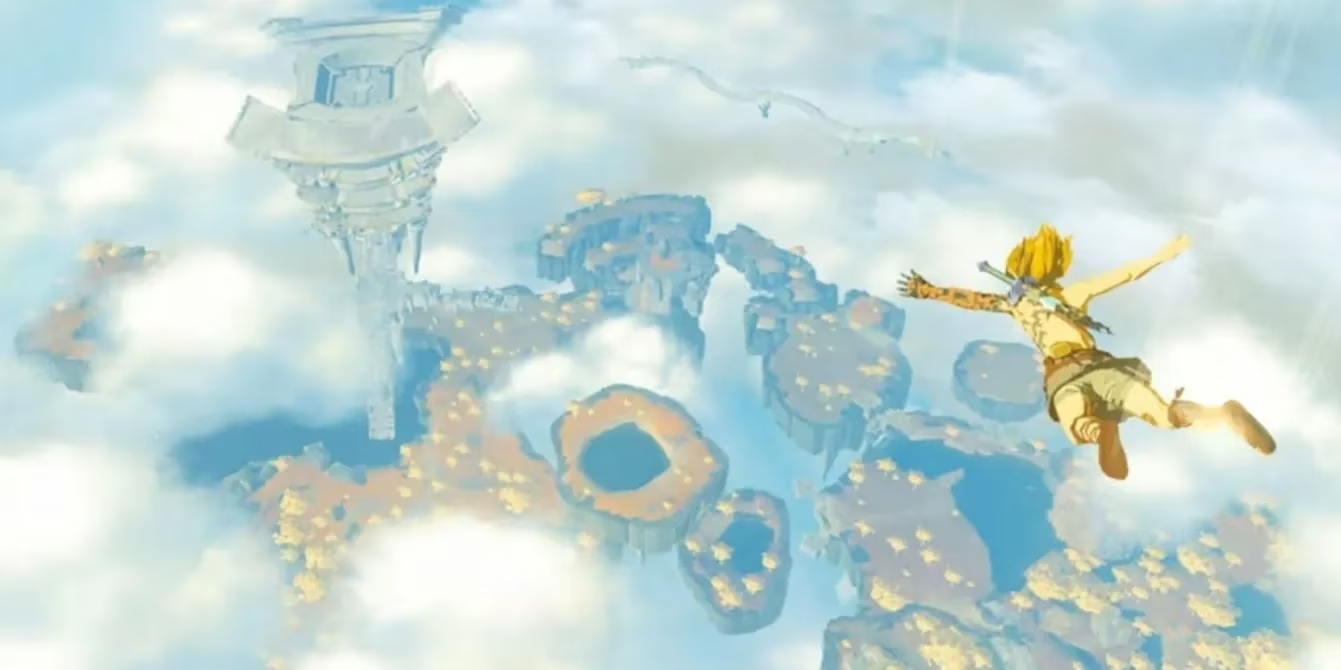
A History of Reinvention: From Ocarina's Shadow to Open-World Sunrise
To understand the current predicament, one must look back. Before Breath of the Wild shattered conventions, the 3D Zelda lineage, beginning with the seminal Ocarina of Time in 1998, had settled into a comfortable—some would say stagnant—pattern. For over a decade, each entry followed a similar design scripture: dungeon keys, linear progression, and predictable item gates. By the time Skyward Sword arrived for the series' 25th anniversary, player appetite for something fresh was palpable. The game's subsequent commercial disappointment acted as a clarion call, a necessary shock to the system that propelled producer Eiji Aonuma and his team toward the radical open-world pivot.
The result was a renaissance. Breath of the Wild and Tears of the Kingdom didn't just succeed; they redefined expectations for the franchise and the genre. However, this very success creates a new kind of template. The series now risks trading one set of predictable patterns (the classic 3D formula) for another (the open-world sandbox). If the next chapter is simply "Breath of the Wild, but with a different gimmick," the franchise might inadvertently walk back into the creative cul-de-sac it so brilliantly escaped.
The Ultrahand Conundrum: A Double-Edged Masterpiece
Here lies the core tension. Tears of the Kingdom's astronomical success is inextricably linked to its revolutionary crafting systems. Ultrahand and Fuse weren't just features; they were a paradigm shift, transforming Hyrule into a physics-driven playground of player expression. The game became a glorious amalgamation of a symphony orchestra and a box of LEGO—offering both epic, composed moments and the tools to compose your own chaos. It justified its existence not just through new maps (the Sky Islands and Depths), but through this core gameplay loop. Taking this away for the next game feels, to many, like a step backward.
Consider the metrics:
-
Fastest-Selling First-Party Switch Title: A record held firmly by TotK.
-
Western Nintendo Sales Record: Another feather in its cap.
-
Sustained Cultural Hype: Largely fueled by viral, player-created contraptions from the crafting systems.
Abandoning this beloved mechanic so soon could be seen as the series voluntarily disarming its own most potent weapon. For the millions of fans who view TotK as the perfect blend of Breath of the Wild's exploration and Minecraft's creativity, a sequel without crafting might feel like a betrayal of the game's soul.
Charting the Course: Where Does Zelda Go From Here?
So, what's the path forward? The solution likely isn't a binary choice between "keep crafting" or "scrap it." Instead, the next evolution must find a way to innovate around or beyond the current foundation. Here are potential avenues the developers might explore:
1. Thematic & Mechanical Specialization: Instead of another blanket "build anything" system, the next game could introduce a more focused, theme-driven mechanic. Imagine:
*   A game centered on **time manipulation** on a grand scale, affecting entire regions and puzzles.

*   A deep **sailing/naval exploration** system where building and customizing a ship is central to traversal and combat.

*   A return to a **dual-world mechanic**, but with a dynamic, player-influenced relationship between them, more complex than *A Link to the Past* or the Light/Dark World.
2. Evolving the Sandbox Formula: The open world itself can be reinvented. What if the world was more reactive, with factions, ecosystems, and kingdoms that evolve based on player actions—a world that feels less like a static painting and more like a living, breathing organism with its own immune response to the player's presence?
3. Narrative Integration: Both BotW and TotK prioritized environmental and emergent storytelling. The next step could be weaving a more direct, player-driven narrative into the sandbox, where major story beats and world states can change organically based on exploration order and choices, without sacrificing freedom.
Conclusion: The Delicate Balance of Legacy and Evolution
The Legend of Zelda franchise is in an enviable yet precarious position. It has climbed to the peak of commercial and critical success with a formula that still feels fresh to its massive audience. The desire for something new is the very instinct that led to its current golden age. The challenge for Nintendo is to harness that same spirit of innovation without making the foundational joys of the last two games feel like a discarded phase. The next Zelda shouldn't just be a new map with a new tool; it needs to be a new philosophy that surprises and delights as profoundly as Ultrahand did, whether that innovation builds upon crafting or replaces it with something equally transformative. The journey beyond the Kingdom's tears will require navigating the narrow straits between familiarity and revolution, ensuring the series continues to be a beacon of adventure rather than becoming a monument to its own past.
Data referenced from NPD Group underscores why Nintendo’s biggest challenge after Tears of the Kingdom isn’t simply “what’s the next gimmick,” but how to sustain blockbuster-scale momentum without locking Zelda into a new kind of formula fatigue. When a single entry helps define a platform era, market performance tends to reward recognizable continuity—yet long-running series also face diminishing returns if iteration starts to feel like repetition. That tension maps cleanly onto Zelda’s current crossroads: the next game must preserve the broad appeal that drove record-breaking sales while still delivering a clear, system-level leap that feels as transformative as the open-world pivot and Ultrahand-driven creativity.