The Evolution of Zelda in Tears of the Kingdom: From Princess to Savior
In the ever-evolving landscape of Hyrule, The Legend of Zelda: Tears of the Kingdom presents a version of its namesake princess that is both familiar and radically transformed. While longtime fans recognize her as the bearer of wisdom and a pivotal figure in the cyclical battle against darkness, this iteration carves out a distinct identity, reshaping her role from a narrative focal point into an active, driving force of the saga. The game masterfully weaves her personal journey into the fabric of Hyrule's ancient past and uncertain future, proving that even the most iconic characters have new depths to explore.
A Modernized Visage: More Than Just a Haircut
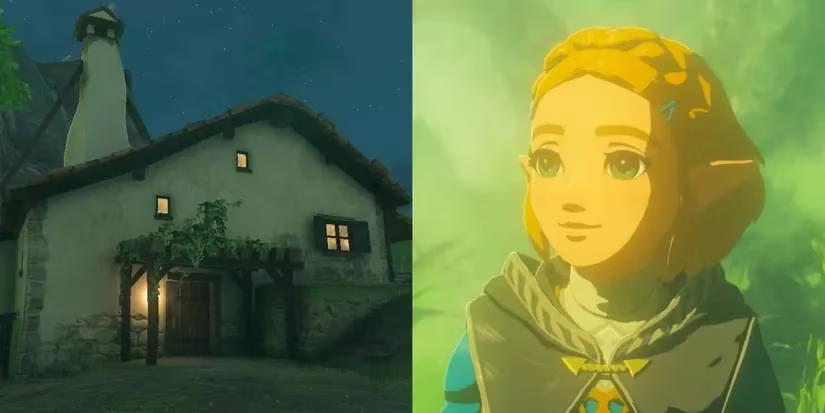
Zelda's appearance has undergone a subtle yet significant shift. Retaining her core features from Breath of the Wild, her most striking change is her shorter, more contemporary hairstyle. This isn't merely a cosmetic tweak; it's a deliberate character choice that moves her away from the traditionally untouchable, regal elegance of past princesses. This new look makes her seem more accessible, more human, and curiously, more akin to the heroic archetype Link himself embodies. It’s a visual metaphor for her readiness to step into the fray, her regality now tempered with a warrior's practicality. Her short hair flows in the wind not like a royal banner, but like the frayed edge of a well-used map, charting a new course.

The Historian Princess: Wisdom as Action
Zelda's defining trait, the Triforce of Wisdom, is no longer a passive blessing but an active pursuit. In Tears of the Kingdom, she is portrayed as a dedicated historian and scholar, obsessed with uncovering and preserving Hyrule's legacy. This is evident from the game's opening, where her fascination with ancient murals sets the plot in motion. She doesn't just possess knowledge; she actively seeks it, constructing a secret study for her research and even helping to establish and oversee a school in Hateno Village to ensure her learnings are passed on. Her wisdom is no longer an innate power but a hard-earned skill, cultivated through study and dedication, much like a master artisan painstakingly restoring a forgotten masterpiece.
A Home of Her Own: The Hateno House
Player familiarity with Hateno Village takes on new meaning. The house that Link could purchase in the previous game has undergone a change in tenure. In the years following the Calamity, this humble abode has become known as Princess Zelda's home. She used it as both a residence and a private study while working to restore the kingdom. This detail is profoundly humanizing; for perhaps the first time, Zelda has a personal space outside the cold stone of Hyrule Castle. It grounds her character, suggesting a life beyond her royal duties and, as many fans speculate, a deeper personal connection with Link. Owning a home is a novelty for the princess, as grounding as a ancient tree putting down roots in new, fertile soil.
The Sage of Time: Architect of Hyrule's Foundation
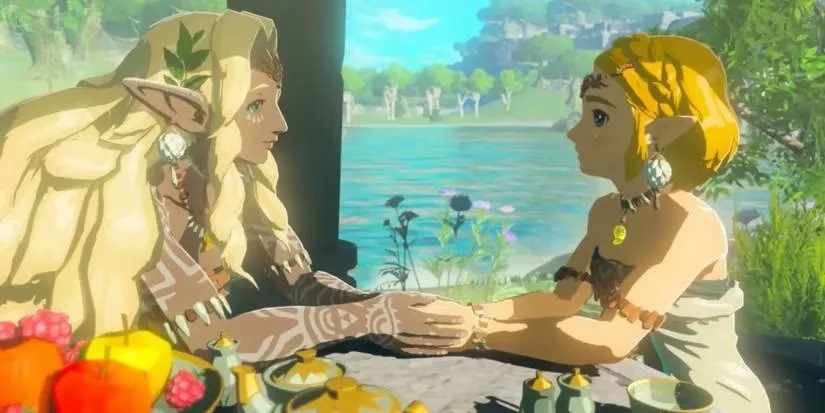
One of the game's central mysteries—Zelda's disappearance—leads to her most impactful role yet. She is hurled back in time to the era of Hyrule's founding, where she encounters her ancestors, Queen Sonia and King Rauru. Here, she is not just an observer but a participant. After witnessing Sonia's death, Zelda formally assumes the mantle of the Sage of Time. While she has held similar titles before, this is the first time she is shown to be directly influential in the kingdom's very creation. She becomes a foundational pillar in the ancient battle against Ganondorf, weaving her destiny into the origin story of the world Link strives to save.
Mastering Recall: A New Temporal Power
This journey to the past unlocks a new facet of Zelda's abilities. Under Queen Sonia's guidance, she learns to harness a unique power born from her lineage: a combination of Sonia's control over time and Rauru's control over light. This manifests as the Recall ability. Zelda actively uses this power to aid Rauru and the sages in their fight, and though she eventually passes this ability to Link, her mastery of it is crucial. It signifies her evolution from a princess who is connected to fate and time to one who can actively command and manipulate those forces for the kingdom's benefit.
The Ultimate Sacrifice: Becoming the Light Dragon
The series is no stranger to transformative, beastly forms for its heroes and villains. Tears of the Kingdom delivers a stunning twist by applying this concept to Zelda. Tasked with restoring and delivering the Master Sword across millennia, she faces an impossible choice. The only way is to consume her Secret Stone and undergo an irreversible transformation into an immortal dragon. This act means sacrificing her mind, her memory, and her very humanity. Zelda willingly makes this sacrifice, becoming the majestic Light Dragon that soars through Hyrule's skies, guarding the restored sword for ages until Link can reclaim it. This is altruism on a cosmic scale, a sacrifice that echoes through time.

From Damsel to Savior: Reversing the Trope
Historically, Princess Zelda has often been positioned as the damsel in distress, the catalyst for Link's quest but not its architect. Tears of the Kingdom powerfully subverts this trope. Link's quest is to find Zelda, not to save her. Throughout the narrative, it is Zelda who performs the heroic, world-saving acts:
-
🗡️ She orchestrates the ancient sages' pledge to aid a hero thousands of years in the future.
-
⏳ She masters and utilizes the Recall ability to influence pivotal past events.
-
🐉 She makes the ultimate sacrifice, transforming into a dragon to preserve the Master Sword.
-
🌄 She endures millennia of draconic madness to ensure Hyrule's future survival.
Her journey is one of proactive salvation. She condemns herself to an eternity of instinct to save a home she may never see again. Upon her restoration at the game's conclusion, she immediately dedicates herself to securing Hyrule's lasting peace. This Zelda is not a prize to be won but a partner in the struggle, a co-author of destiny whose courage and sacrifice are the very bedrock upon which Link's victory is built. In Tears of the Kingdom, Princess Zelda doesn't just need a hero; she becomes one.