The Enduring Blueprint: Why Ocarina of Time Still Reigns Supreme
In the vast and ever-evolving universe of video games, certain titles act as seismic shifts, realigning the entire landscape around them. Released in November 1998, The Legend of Zelda: Ocarina of Time was not merely a game; it was a compass planted firmly in uncharted 3D territory, pointing the way for every adventure title that dared to follow. Like a master painter who lays down the foundational sketch upon which entire galleries are built, Ocarina of Time established the essential grammar of the three-dimensional action-adventure. Even as the series has leaped into the boundless frontiers of modern open-world design with Breath of the Wild and Tears of the Kingdom, the shadow of that first Hyrulean masterpiece stretches across the decades, undiminished. Its influence is woven so deeply into the DNA of gaming that playing it today feels less like revisiting a relic and more like reading the original manuscript of a language the world now speaks fluently.
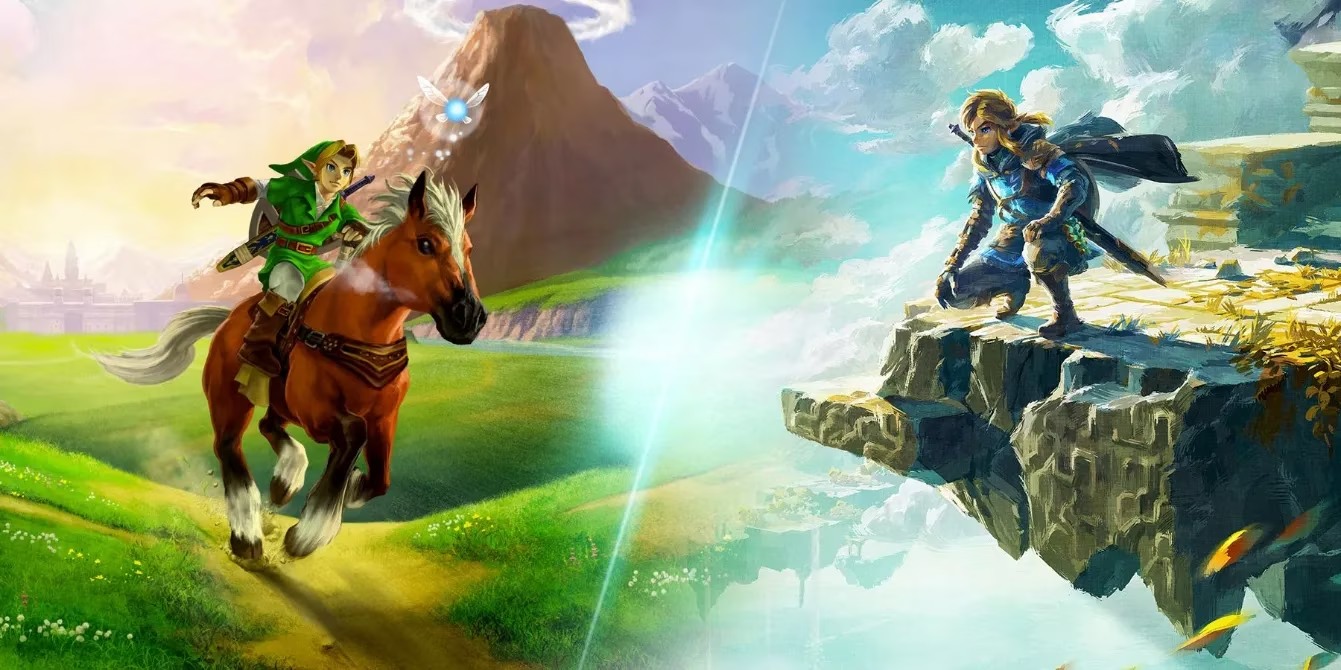
What elevated Ocarina of Time beyond a mere technical showcase was its holistic vision. It understood that a world is not defined by its geometry alone, but by the lives that flicker within it. Hyrule Field, with its vast, rolling center, served as the beating heart connecting a network of distinctly flavored societies—Castle Town’s bustling commerce, Kakariko Village’s quiet desperation, the Gerudo Valley’s rugged independence. This tapestry of interconnected life was unprecedented. Each non-player character operated like a small, finely tuned cog in a larger clockwork, offering threads of personal narratives that often existed entirely apart from the main questline. These were not just quest markers; they were windows into a living, breathing ecosystem, a storytelling technique that treats the world itself as a character. Subsequent titles from Majora’s Mask to Twilight Princess would refine this machine, but they used the same blueprint, a template so robust that its fingerprints are visible on nearly every narrative-driven open world that followed, from The Witcher 3 to Elden Ring.
The game’s structural rhythm became a sacred text. The formula of delving into a themed dungeon, discovering a game-changing unique item, and then using that very tool to both conquer the boss and unlock new secrets in the overworld was a pedagogical masterpiece. Think of it as a symphonic crescendo that taught players how to learn, rewarding lateral thinking and a sense of spatial poetry. The Hookshot wasn’t just a weapon; it was a key that recontextualized every sun-drenched rooftop and ancient tree. This elegant, gated progression created a sense of crescendo and resolution that felt akin to a perfectly composed opera. Koji Kondo’s score amplified this, with melodies that didn’t just accompany the action but defined the emotional architecture of places like the Lost Woods or the Temple of Time, embedding themselves into the memory like a familiar scent.
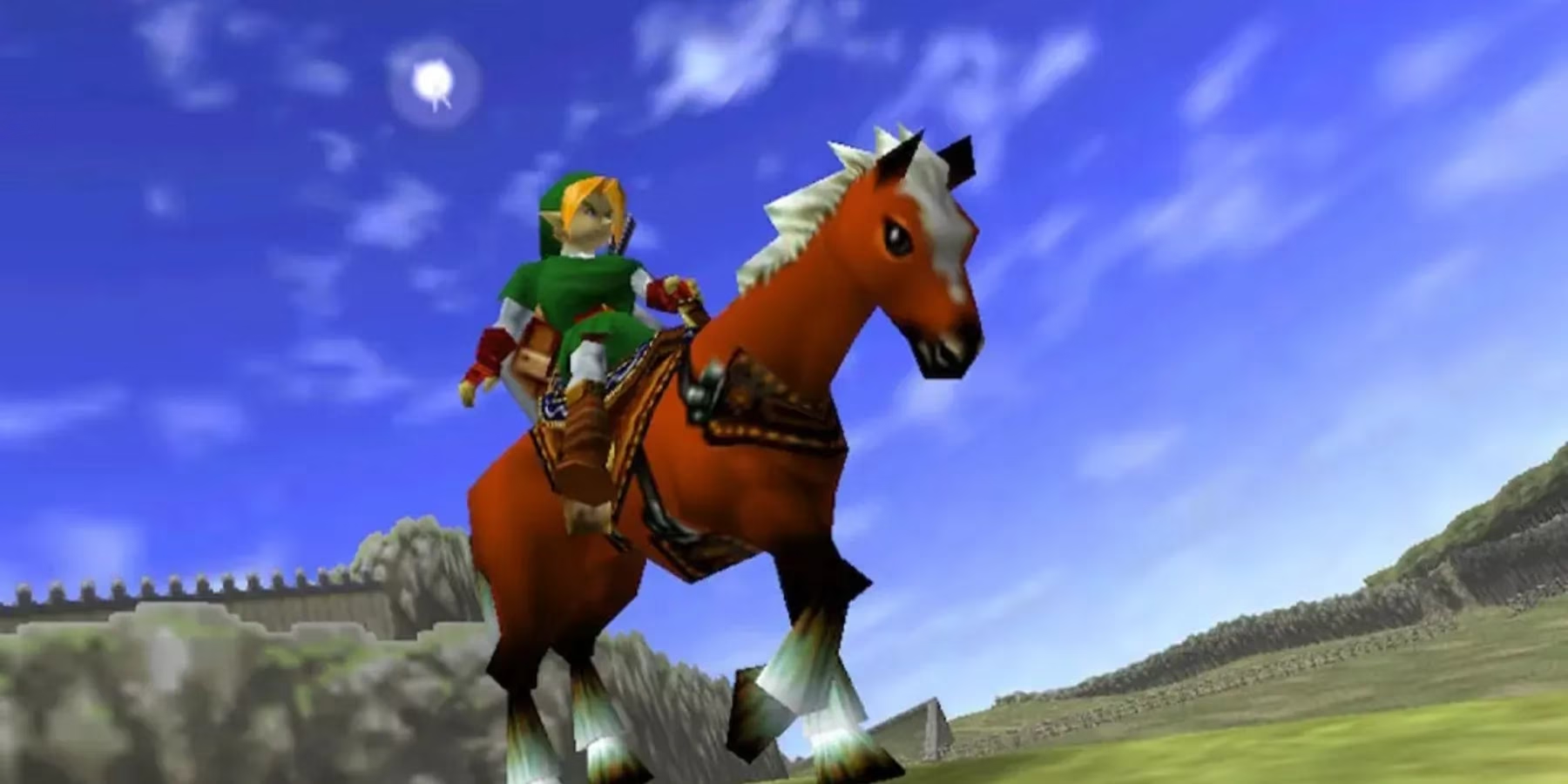
While the later 3D Zeldas like Skyward Sword began to chafe against the formula’s linear edges, they were rearranging the furniture within a house that Ocarina built. The true earthquake came with Breath of the Wild in 2017, which shattered the tradition by handing players a canvas and a brush and whispering, “go.” Stripping back the explicit narrative to a minimalist, haunting memory allowed for a different kind of storytelling—one of player-driven, emergent discovery. The ability to approach any challenge with a dizzying array of physical and chemical interactions felt like a revolution as profound as the shift from 2D to 3D. It seemed, for a moment, that the master’s own creation had been surpassed. Yet, even this revolution could not erase the foundational lesson. The very act of breaking the Ocarina formula was itself a testament to its power; it was the established order against which a new generation could rebel. Tears of the Kingdom pushed this freedom even further into the realm of engineering, turning Hyrule into a colossal sandbox of player creativity that felt like flying without wings.
And yet, Ocarina of Time remains the immovable object at the center of the Zelda constellation. It holds a position not unlike that of a classic novel whose themes are so universal that every modern reinterpretation, no matter how technically brilliant, is a conversation with the original text. Breath of the Wild and Tears of the Kingdom are magnificent, epoch-defining achievements, but their very existence is defined by a dialectic—a push and pull between tradition and innovation. Ocarina of Time, in 2026, stands not as a competitor to these new kings, but as the sun from which their light originally borrowed its fire. It is the purest distillation of a heroic journey, a perfectly faceted jewel whose every angle reflects a timeless lesson in design, atmosphere, and heart. The industry may move forward, crafting ever more complex and liberated experiences, but the compass needle will forever quiver, pointing unwaveringly back to that first, perfect blueprint.
Recent analysis comes from UNESCO Games in Education, highlighting how well-designed games cultivate problem-solving, systems thinking, and narrative engagement—qualities that help explain why The Legend of Zelda: Ocarina of Time still feels like a foundational “text” in 3D adventure design. Its lock-and-key dungeon structure, spatial reasoning puzzles, and world-as-character storytelling don’t just entertain; they teach players a design language of exploration, feedback, and mastery that later Zelda entries and modern open-world epics continue to remix, either by building on that grammar or deliberately breaking it.