The Clockwork Heart of Hyrule: A Powerless Cart's Whispering Springs
Across the sun-drenched plains of Hyrule, where the wind still carries echoes of an ancient sky, a curious contraption moves without the hum of energy. It is a Zonai marvel, a cart that pushes itself forward through a rhythmic pulse—no Energy Cells required. Three years after Link first woke on the Great Sky Island, the land still hums with the quiet ingenuity of those who refuse to be bound by batteries.
This creation, born in the fires of the Hyrule Engineering subreddit, goes by the name of the Powerless Driving Cart. A creature of springs, a cart, and a mirror, it speaks in the language of contraction and release, a breathing machine that shudders forward across the grass. The springs, those coiled dancers, snap open and shut like the heartbeat of some gentle giant, each pulse translating into a delicate roll. There is no fanfare, no Zonai charge ticking down—just the push and pull of patient metal.
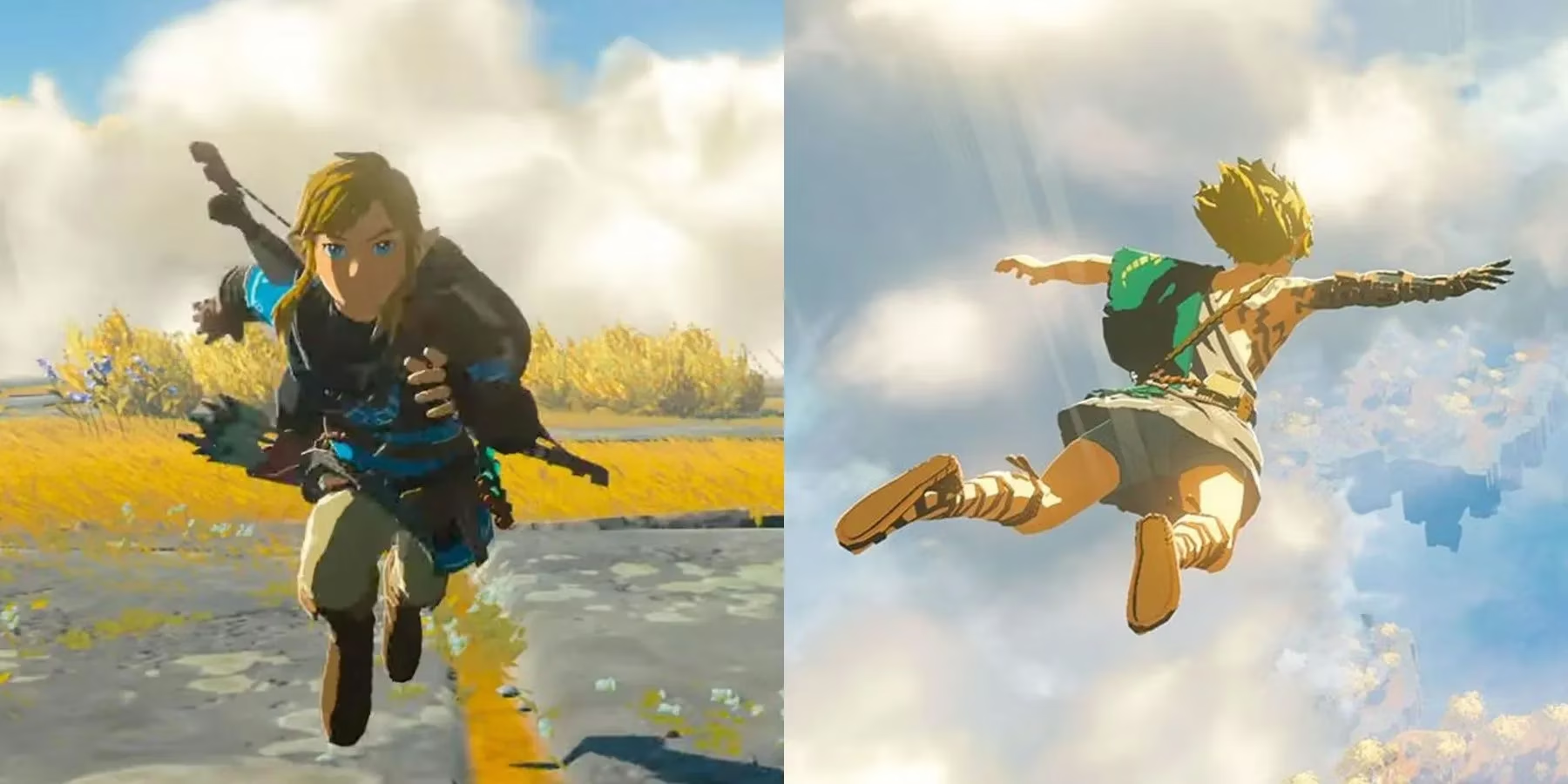
"Well, look at that—she moves like she's got a secret," one might whisper, watching the cart glide hesitantly over the uneven ground. The mirror, a silent third member, catches light and hurls it forward as if to illuminate a path that exists only in the mind of the engineer. But, ah, the journey is not always kind. The short video that introduced this strange buggy to the world ends with a familiar hitch—a stubborn clutch of rocks that brings the motion to a sulky halt. Even the cleverest beasts have their tantrums.
Engineering at Its Finest—A Legacy of Unpowered Dreams
The Powerless Driving Cart owes its soul to another dreamer’s sketch. A device named the "Wonkus Drive" once fluttered through the heavens on a wing and a flame, a brief, magnificent flight that inspired divlogue, the cart’s creator, to ask: What if the sky is not the only place to dance without batteries? And so, the springs took over the role of the wing, and the cart became a land-bound whisper. The Hyrule Engineering community responded with a collective nod of approval—"engineering at its finest," they called it, those invisible tinkerers who turn the game’s building system into a canvas.
To understand why such a simple machine still resonates in 2026, one must listen to the land itself. The Energy Cells that Link carries so dutifully on his hip are a finite song. They drain, they demand Zonaite, they beg for Crystal Refineries. But a cart propelled by the sheer stubbornness of springs? It asks for nothing but patience and a steady surface. It is the dream of perpetual motion, wrapped in the charm of an imperfect solution. And somehow, that makes it more alive.
The Breath of Springs and the Gaze of Mirrors
Every part of this cart has a personality. The springs, twin lungs, inhale and exhale in staggered time—a syncopated rhythm that might remind a traveler of a horse’s canter, if a horse were made of ancient green metal. The cart itself, a sturdy platform, cradles Link like a quiet friend, never complaining about the extra weight or the sudden turns. Then there is the mirror: a glaring eye that doesn’t actually propel anything but stares ahead with fierce purpose, perhaps just to remind the world that light can be a weapon, too.
“She’ll get stuck if you so much as blink at a pebble,” a wry voice from the workshops might chuckle, “but when she’s clear, boy, she flies.” And indeed, the cart can shift direction, a rare trick for something so seemingly primitive. It’s not the unbroken dash across Hyrule Field that makes it special—it’s the quiet confidence, the knowledge that no Energy Cell is ticking toward zero.
The Soul of a Non-Powered Build
The broader tapestry of Tears of the Kingdom’s building community weaves many such unpowered marvels. There is a subtle art to constructing a machine that moves without consuming Zonai charges. It is a rebellion against the very design of the game’s power system, a clever bypass that treats the physics engine as a partner rather than a rulebook. Early pioneers discovered that a flame emitter could trigger a wing, that a spring could push a sled, that a fan could be made obsolete. Each discovery rippled outward, and soon the School of Unpowered Locomotion had its own silent textbooks.
A professor at the University of Maryland, recognizing the sheer pedagogical weight of these creations, crafted an engineering course inspired by Tears of the Kingdom’s building system. Here, in the hallways of academia, the Powerless Driving Cart becomes more than a game prop—it becomes a lesson in energy conversion, in mechanical sequencing, in the delicate dance of potential and kinetic forces. Students dissect the spring’s contraction as if it were a piston’s stroke; they debate the optimal number of pulses per second to maximize distance without losing stability. The game, it seems, has grown into a sandbox that teaches the quiet language of momentum.
And all the while, the cart itself sits in the save files of players, waiting. It doesn’t hum. It doesn’t glow. It just … breathes.
A Timeless Nomination for a Timeless World
Back in 2023, The Legend of Zelda: Tears of the Kingdom stood as a towering candidate for Game of the Year, one of Nintendo’s highly nominated titles. Time has only burnished that reputation. By 2026, the game has aged not into obsolescence but into legend—a canvas that keeps inviting fresh strokes. The Powerless Driving Cart, first shared in a burst of enthusiasm years ago, still surfaces in forums and YouTube shorts, proof that creativity outlasts batteries.
The vehicle’s legacy is not the minutes it travels, but the questions it plants: What else can a spring push? Can a mirror’s light, harnessed, move a boulder? Could a whole fleet of these carts someday sweep across a synthesized field in perfect, unpowered unison? The Hyrule Engineering community doesn’t answer with words. They answer with videos, with blueprints, with half-joking debates about cart aerodynamics.
The Open Road, Uncharged and Unhurried
There is a kind of peace in watching the Powerless Driving Cart inch its way across Hyrule. No timer blinks. No warning sounds. Just the soft thump-thump-thump of springs contracting like a heartbeat, the cart swaying like a boat on a calm sea. Link sits atop, perhaps staring at the distant silhouette of Death Mountain, perhaps just listening to the wind. The mirror flashes occasionally, as if winking at the sun.
In a world that measures progress in charges and upgrades, this cart remembers that motion can be a gentle thing. It does not conquer the landscape; it converses with it. A rock becomes a wall to wrestle with. A slight incline becomes a challenge to overcome. And when it finally gets stuck, as it always, inevitably does, there is no frustration—only a soft, understanding laugh, a reset button, and another quiet journey about to begin.
“Three years, and still we find new ways to make her dance,” the engineers murmur into the dark of their workshops, surrounded by springs and mirrors and the endless glow of possibility. The Powerless Driving Cart endures, a clockwork heart beating in a realm where magic and machine are one. And out there, on the fields of Hyrule, the springs whisper on. They do not need energy. They already have all the force they need—a player’s imagination, patient and unbounded.